
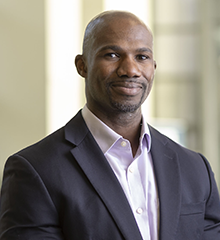
Ajiboye, A Bolu, PhD
PROFESSIONAL AFFILIATIONS
Investigator & Executive Committee Member
Cleveland FES Center
Professor and Chair, Department of Biomedical Engineering
Case Western Reserve University
Biomedical Engineer & Investigator
Louis Stokes Cleveland VA Medical Center
Director
Laboratory for Intelligent Machine Brain Systems (LIMBS)
Elected Board Member
International BCI Society
CONTACT INFORMATION
Program Contact:
A. Bolu Ajiboye
Phone:
(216) 368-6814
Laboratory Website:
https://rehabstudy.org
Email:
bolu.ajiboye@case.edu
Abidemi (Bolu) Ajiboye, PhD, is Professor and Chair of the Department of Biomedical Engineering at Case Western Reserve University and a Biomedical Engineer at the Louis Stokes Cleveland VA Medical Center.
He directs the Laboratory for Intelligent Machine Brain Systems (LIMBS) and serves as the Scientific Principal Investigator of the Reconnecting the Hand and Arm to the Brain (ReHAB) Clinical Trial, a translational program focused on restoring upper limb motor and sensory function in individuals with chronic paralysis.
Dr. Ajiboye’s research integrates systems neuroscience, intracortical neural recording, motor decoding, neuromuscular electrical stimulation, sensory neuroprosthetics, and closed loop control. His work includes landmark demonstrations showing that individuals with tetraplegia can achieve functional reaching and grasping using brain controlled functional electrical stimulation (FES), with findings published in leading journals including The Lancet, Neurosurgery, eNeuro, and Nature Biomedical Engineering.
RESEARCH PROGRAMS
- Brain-Controlled Functional Electrical Stimulation – Dr. Ajiboye leads clinical research developing intracortical BCI FES systems that enable individuals with spinal cord injury to restore voluntary arm and hand movement. His team designs motor intent decoding algorithms and neuromuscular stimulation strategies that support naturalistic, functional motor behavior, and has demonstrated that individuals with chronic tetraplegia can achieve functional reaching and grasping via voluntary, brain-driven FES systems—a milestone published in The Lancet and other leading journals.
- Sensory Restoration via Intracortical Microstimulation – Builds upon the core research by restoring tactile sensation through multi-electrode cortical stimulation, creating sensory feedback loops that enable naturalistic touch in neuroprosthetic control systems.
- Neural Encoding of Motor Intent – Studies how the human motor cortex represents force, grasp type, and imagined or attempted movements in individuals with chronic paralysis. These investigations inform more intuitive BCI decoding strategies and reveal fundamental neural mechanisms underlying motor control.
- Muscle Synergies & Naturalistic Control – Explores how coordinated muscle activation patterns (synergies) can be leveraged to command neuroprosthetic systems, supporting more efficient and naturalistic upper limb control.
- Intracortical Device Safety & Neurophysiology – As a collaborator on multi-site efforts, Dr. Ajiboye contributes to studies on long term intracortical implant safety, neural ensemble dynamics during speech and motor tasks, and the neural mechanisms underlying closed loop BCI control.
MAJOR PROJECTS & FUNDING
- Principal Investigator, VA Merit Review Grant: Development of FES+BMI Neuroprosthesis for At-Home Use for Persons with Chronic Tetraplegia.
- Scientific PI, ReHAB Clinical Trial, integrating motor and sensory restoration strategies for individuals with chronic spinal cord injury.
- Lead investigator on projects exploring intracortical microstimulation for tactile feedback, neural encoding of force and grasp, synergy based control, and neural interface performance.
HONORS & RECOGNITION
- Presidential Early Career Award in Science and Engineering (PECASE), 2026
- Allen H. and Constance T. Ford Endowed Professor and Chair
- Robert and Brenda Aiken Endowed Chair in Biomedical Engineering (2024-2026)
- Elmer Lincoln Lindseth Endowed Chair in Biomedical Engineering (2020–2024)
- First Place Award, International BCI Society (2019)