
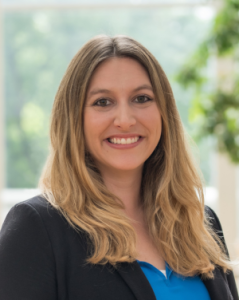
Graczyk, Emily, PhD
PROFESSIONAL AFFILIATIONS
Investigator
Cleveland FES Center
Assistant Professor
Dept. of Biomedical Engineering, Case Western Reserve University
Biomedical Engineer
Louis Stokes Cleveland VA Medical Center
CONTACT INFORMATION
Program Contact:
Emily Graczyk
Contact Number:
(216) 368-5182
Contact Email:
emily.graczyk@case.edu
Emily Graczyk, PhD, is an Assistant Professor in the Department of Biomedical Engineering at Case Western Reserve University, a Biomedical Engineer at the Louis Stokes Cleveland VA Medical Center, and an Investigator with the Cleveland FES Center.
Her research focuses on developing and clinically evaluating neural interfaces and stimulation approaches that restore and enhance somatosensory function for people with sensory impairments resulting from limb loss or spinal cord injury.
Dr. Graczyk studies how the nervous system creates and processes sensory experiences, including touch, proprioception, and other dimensions of somatosensation. For more than a decade, her research has investigated how electrical stimulation of the peripheral nervous system can provide meaningful sensory feedback to people with upper limb loss. Her work combines neural engineering with psychophysics, neuroscience, behavioral assessment, computational modeling, and qualitative research to understand not only how artificial sensations are perceived, but also how they affect function, confidence, prosthesis use, and quality of life.
A major focus of Dr. Graczyk’s research is the development and clinical evaluation of bidirectional neuroprostheses—systems that can both obtain motor commands from the nervous system and return sensory information to the user. Her laboratory conducts early feasibility clinical trials of implanted neurotechnologies for sensory and sensorimotor restoration. Through the Reconnecting the Hand and Arm to the Brain (ReHAB) clinical trial, her team studies touch sensations produced by intracortical microstimulation and neural activity recorded from the somatosensory cortex in people with tetraplegia. Her research also includes peripheral nerve stimulation approaches designed to restore touch and proprioception for people with limb loss.
Dr. Graczyk places particular emphasis on translating neurotechnology beyond the laboratory and understanding its impact on people’s everyday lives. Her research has included pioneering studies in which people with limb loss independently used sensory-enabled prostheses at home and in their communities for extended periods. These studies demonstrated that restored sensation can improve prosthesis function and use while also enhancing the psychosocial experience of using a prosthetic limb. Her laboratory also works directly with users to understand their needs, priorities, and experiences, helping ensure that emerging neurotechnologies address outcomes that are meaningful to the people who will ultimately use them.
RESEARCH PROGRAMS
- Sensory Neuroprostheses: Development and clinical assessment of implanted neural interfaces designed to restore touch, proprioception, and other somatosensory experiences for people with limb loss or spinal cord injury.
- Peripheral Nerve Stimulation for Sensory Restoration: Investigation of electrical stimulation delivered through implanted peripheral nerve interfaces to evoke meaningful tactile and proprioceptive sensations. Dr. Graczyk’s work examines how stimulation parameters influence the intensity, quality, timing, and naturalness of artificial sensation.
- Intracortical Sensory Neuroprostheses: Study of sensory restoration through intracortical microstimulation of the primary somatosensory cortex in people with tetraplegia, including characterization of stimulation-evoked touch and neural responses to natural peripheral sensation.
- Bidirectional Neuroprosthetic Systems: Development and clinical evaluation of systems that integrate sensory feedback with motor control, creating more intuitive and functional neuroprostheses for people with paralysis or limb loss.
- Proprioception Restoration: Development of peripheral nerve stimulation approaches designed to restore a sense of hand and limb position for upper limb prosthesis users, with the goal of improving intuitive prosthesis control and sensorimotor integration.
- Home and Community Use of Neuroprostheses: Evaluation of sensory-enabled prostheses outside the laboratory to understand how restored sensation affects real-world prosthesis function, usage, learning, embodiment, and psychosocial experience.
- User-Centered Neurotechnology: Investigation of the needs, priorities, and experiences of people who use prostheses and neurotechnologies, with the goal of incorporating end-user perspectives into technology development and clinical translation.
- Neuroprosthetic Outcomes Assessment: Development and validation of functional and patient-reported outcome measures that can accurately assess the benefits of restored sensation and sensory-enabled prostheses
MAJOR PROJECTS & FUNDING
- Reconnecting the Hand and Arm to the Brain (ReHAB) Clinical Trial: Dr. Graczyk’s laboratory leads sensory restoration research within the ReHAB clinical trial, investigating sensations produced through intracortical microstimulation of the somatosensory cortex in people with tetraplegia. The team has also contributed to the development and clinical assessment of implanted bidirectional neuroprosthetic systems for restoring sensorimotor function.
- NIH NICHD R01 – Sensory Feedback Following Spinal Cord Injury: Dr. Graczyk and collaborators received NIH NICHD R01 funding to optimize brain and peripheral nerve stimulation approaches for providing sensory feedback to people with spinal cord injury.
- VA RR&D Merit Review – Restoration of Proprioception: As Principal Investigator of a VA Rehabilitation Research and Development Merit Review, Dr. Graczyk is developing and evaluating peripheral nerve stimulation approaches to restore proprioception for people who use upper limb prostheses.
- Bidirectional Neuroprosthesis Clinical Trial: Dr. Graczyk leads a pilot randomized controlled trial evaluating a bidirectional neuroprosthesis designed to provide both sensory feedback and intuitive prosthesis control for people with upper limb amputation. The project is funded by the Congressionally Directed Medical Research Programs’ Peer Reviewed Medical Research Program (CDMRP PRMRP).
- Upper Limb Prosthesis User Needs Research: Dr. Graczyk has led multiple survey and interview studies examining the experiences and unmet needs of people who use upper limb prostheses and neuroprostheses, including two studies funded through the CDMRP Orthotics and Prosthetics Outcomes Research Program (OPORP).
- Home Use of Sensory-Enabled Prostheses: Dr. Graczyk led pioneering research evaluating neural-connected sensory prostheses during independent home and community use. In an early study, participants with upper limb loss used a sensory restoration system outside the laboratory for multiple weeks, demonstrating improvements in prosthesis function, use, and psychosocial experience.
- Somatosensory Electrical Neurostimulation and Sensing (iSens) System: Dr. Graczyk’s team contributed to development of the implanted iSens system and assessment of clinical outcomes in its first pilot participants as part of broader efforts to create bidirectional systems for sensory restoration and prosthesis control
HONORS & RECOGNITION
-
- 2025 Blavatnik Award Nominee, Blavatnik Awards for Young Scientists
- 2024 “Who to Know in Brain Computer Interfaces,” STAT News
- 2023 Innovation Award, Case Western Reserve University
- 2021 Think Big Leadership Award, Case Western Reserve University
- 2018 DARPA Riser, Defense Advanced Research Projects Agency
- 2018 Graduate Excellence Award, Case Western Reserve University
- 2017 Outstanding Publication Award, Case Western Reserve University
- 2017 Student Podium Presentation Award, Myoelectric Controls Symposium
- 2014 NSF Graduate Research Fellowship, National Science Foundation