
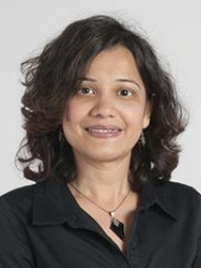
Ghasia, Fatema, MD
PROFESSIONAL AFFILIATIONS
Investigator
Cleveland FES Center
Professor of Ophthalmology
Cleveland Clinic Lerner College of Medicine of CWRU
Staff, Pediatric Ophthalmology and Adult Strabismus
Cole Eye Institute, Cleveland Clinic
Director, Visual Neurosciences and Ocular Motility Laboratory
Cole Eye Institute
Research Appointment
Daroff and Dell’Osso Ocular Motility Laboratory, Louis Stokes Cleveland VA Medical Center
Site Investigators
Pediatric Eye Disease Investigator Group (PEDIG)
CONTACT INFORMATION
Program Contact:
Fatema Ghasia
Contact Number:
(216) 444-2020
Contact Email:
ghasiaf@ccf.org
Fatema Ghasia, MD, is a Professor at the Cleveland Clinic Lerner College of Medicine of Case Western Reserve University, Staff in Pediatric Ophthalmology and Adult Strabismus at Cleveland Clinic’s Cole Eye Institute, and an Investigator with the Cleveland FES Center.
Dr. Ghasia directs the Visual Neurosciences and Ocular Motility Laboratory at the Cole Eye Institute, where her research bridges ophthalmology, systems neuroscience, visual science, and neuroengineering to better understand and treat disorders of vision and eye movement.
A clinician-scientist and strabismus surgeon, Dr. Ghasia studies the neural mechanisms underlying visual function and ocular motor control, with particular emphasis on strabismus, amblyopia, nystagmus, and visual abnormalities associated with neurological and neurodegenerative disorders. Her laboratory uses high-precision eye and head movement tracking, three-dimensional video-oculography, visual psychophysics, electrophysiology, and computational approaches to identify objective measures of visual and ocular motor dysfunction. These tools allow her team to investigate binocular coordination, fixation, saccades, vergence, depth perception, contrast sensitivity, visual acuity, color vision, and motion perception.
Dr. Ghasia’s research spans both pediatric and adult populations. Her work has helped establish eye movement abnormalities as clinically meaningful biomarkers of neural dysfunction in conditions including cerebral palsy, Parkinson’s disease, cerebellar ataxias, amblyopia, and strabismus. By quantifying subtle changes in eye movements and visual performance, her research seeks to improve diagnosis, predict treatment outcomes, monitor disease progression, and identify new therapeutic targets. Her laboratory has also investigated how interventions such as strabismus surgery and deep brain stimulation affect ocular motor function.
A central goal of Dr. Ghasia’s research is to translate advances in neuroscience and engineering into more precise approaches to clinical care. Her recent work includes artificial intelligence-based analysis of eye movement data for early amblyopia detection, investigation of eye movement biomarkers for neurological disease, and exploration of neuromodulation as a strategy for visual rehabilitation. She is also a site investigator for the NIH-funded Pediatric Eye Disease Investigator Group (PEDIG), a national clinical research network studying binocular vision and ocular motility disorders.
RESEARCH PROGRAMS
- Visual Neuroscience and Ocular Motor Control: Investigation of the neural circuits responsible for eye movements, gaze stabilization, binocular coordination, and visual function, including the roles of the brainstem, cerebellum, basal ganglia, and sensory systems in ocular motor control.
- Strabismus and Binocular Vision: Investigation of the neural and mechanical mechanisms underlying strabismus, with an emphasis on using quantitative eye movement measurements to better understand disease mechanisms, identify prognostic markers, and improve surgical and functional outcomes.
- Amblyopia and Fixational Eye Movements: Study of fixation instability and other ocular motor abnormalities in amblyopia, including their relationships with visual acuity, stereoacuity, contrast sensitivity, reading, visual search, and treatment outcomes.
- Neuromodulation and Visual Rehabilitation: Investigation of neuromodulation approaches for visual system dysfunction, including non-invasive brain stimulation for residual amblyopia and the effects of deep brain stimulation on ocular motor function.
- Eye Movement Biomarkers in Neurodegenerative Disease: Use of high-resolution eye movement recordings to characterize visual and ocular motor abnormalities associated with Parkinson’s disease, cerebellar disorders, and other neurological conditions, with the goal of developing biomarkers for diagnosis, disease progression, and treatment response.
- Pediatric Neurological Vision Disorders: Investigation of visual sensory and ocular motor deficits in children with neurological conditions, including cerebral palsy, prematurity, strabismus, and amblyopia, and evaluation of factors associated with treatment and surgical outcomes.
- AI and Precision Diagnostics: Integration of artificial intelligence and quantitative eye movement data to develop objective, scalable approaches for detecting amblyopia and other visual disorders and predicting disease severity and treatment outcomes.
MAJOR PROJECTS & FUNDING
- Visual Neurosciences and Ocular Motility Laboratory: Dr. Ghasia directs the laboratory at Cleveland Clinic’s Cole Eye Institute, which has developed advanced infrastructure for simultaneous high-precision eye and head movement tracking, three-dimensional video-oculography, dynamic vergence and saccade-vergence analysis, automated strabismus measurement, and visual psychophysics. The laboratory has recruited more than 300 research participants.
- Deep Brain Stimulation and Ocular Motor Function: Dr. Ghasia investigates the effects of deep brain stimulation on eye movements and visual function. Current work includes using eye movement recordings to evaluate potential adverse effects and therapeutic benefits of cerebellar deep brain stimulation for essential tremor.
- Parkinson’s Disease and Eye Movement Biomarkers: Research using high-resolution video-oculography has identified abnormalities in vergence, eye alignment, visual search, and saccadic behavior in Parkinson’s disease. Dr. Ghasia’s work has also examined how subthalamic nucleus deep brain stimulation affects binocular coordination and strabismus.
- Amblyopia Precision Diagnostics and Treatment: Dr. Ghasia’s laboratory uses eye tracking, dichoptic visual paradigms, and artificial intelligence to identify objective biomarkers of amblyopia and binocular dysfunction. This research is helping establish quantitative approaches for diagnosis, prognosis, and assessment of treatment efficacy.
- Pediatric Eye Disease Investigator Group (PEDIG): Dr. Ghasia serves as a site investigator for the NIH-funded Pediatric Eye Disease Investigator Group, a national network conducting clinical trials in binocular vision and ocular motility disorders.
- Non-Invasive Brain Stimulation for Amblyopia: In collaboration with Dr. Plow’s laboratory, Dr. Ghasia’s team has investigated non-invasive brain stimulation as a potential treatment approach for older children and adults with residual amblyopia.
- International Collaborative Research: Dr. Ghasia received a 2025–2026 International Collaborators Award from Research to Prevent Blindness, supporting her broader collaborative research in ophthalmology and visual neuroscience.
HONORS & RECOGNITION
-
- International Collaborators Award, Research to Prevent Blindness, 2025–2026
- Nominated Member, American Ophthalmological Society, 2025
- Tracy L. Hull Mid-Career Professional Development Grant, Cleveland Clinic Foundation, 2025
- Scholarship Award, Cleveland Brain Health Initiative, 2021
- Faculty Honor Award, American Academy of Pediatric Ophthalmology and Strabismus, 2020
- Walt and Disney Amblyopia Research Award, Research to Prevent Blindness, 2020
- Young Investigator Award, American Academy of Pediatric Ophthalmology and Strabismus, 2015
- Fellowship Award, Pediatric Cataract and Glaucoma Foundation, 2012
- Research Award, Knights Templar Eye Foundation, 2012
- Advocacy Ambassador Award, American Academy of Pediatric Ophthalmology and Strabismus, 2010
- Rosenbaum Resident Research Award, Washington University in St. Louis, 2010
- Gold Medal, Indian Medical Association, 2002
- Indumati Patel Gold Medal, Maharaja Sayajirao University, 2002